Sunday, October 19, 2008

Sixteen Candles - John Hughes Update #1

Part of me feels like a presidential candidate needing to hold a press conference explaining my actions. For reasons unknown, movies were not a part of my childhood. My family isn't cinephilic in the least. Mom likes going, but Dad just can't understand why anyone would want to spend two hours of a sunny weekend in a dark theater. What is the fallout of all this? Charley has seen only one John Hughes movie: Ferris Bueller's Day Off.

And I don't even like it! Cameron's (Alan Ruck) phone conversation with principal Rooney is the only funny part. I can't buy Broderick either. His demeanor is awkward and I don't think he can carry a movie. Election (Alexander Payne, 1999) works for me because Broderick's Jim McAllister IS Matthew Broderick!

What John Hughes films haven't I seen? Sixteen Candles, The Breakfast Club, and Pretty and Pink. When my friends discuss these films, I stay silent. Having not seen them, I don't have anything to contribute. So, when I admitted that I had not seen this Molly Ringwald trilogy, I am surprised there wasn't an earthquake from all the jaws hitting the floor. It's surprising for two reason. The first is that these films are quintessential coming-of-age tales for my generation (those born in the early to mid-eighties). The second is that these films are about high school, something that I love. I could watch She's All That (Robert Iscove, 1999) and Can't Hardly Wait (Harry Elfont & Deborah Kaplan, 1998) anytime. If they're on television, I can't turn away.

My friends were very willing to help. MH lended Sixteen Candles. I decided to watch this trilogy in chronological order, so let's begin with Candles. Ringwald's Samantha is immediately recognizable as an outcast teen. She has her own circle of friends, but is obviously not part of the jock and motorcycle crowd. To make matters worse, her family forgot her sixteenth birthday. The film follows her day at school. The object of her desire is typical jock-with-money Jake Ryan (Michael Schoeffling). The quest brings these two characters together.

Ultimately, the reason to watch this film is for The Geek (Anthony Michael Hall). A courageous outsider with stereotypical prowess with technology. At first only interested in obtaining the underwear of a girl, Candles of course finds his reputation soaring like an exponential curve. An unlikely partnership forms between Jake Ryan and The Geek. The Geek has information about Samantha that Jake Ryan wants. Jake Ryan has a girlfriend that he is all too happy to dump on The Geek, who is all too happy to take her.

If you've seen any teen comedy, then you know where all this is headed and I don't need to explain it to you. In the end, I think I was a little disappointed. I like Molly Ringwald as the lead, but Schoeffling mails it in. His best scene is with The Geek, but only because Anthony Michael Hall CAN carry the scene. Schoeffling only serves as the eye candy.

A post on The Breakfast Club is coming...

Tuesday, October 14, 2008

Do the Subtle Performances Win Awards?

The recent past shows actors garnering praise for flamboyant performances. Think Johnny Depp in Gore Verbinski's Pirates of the Caribbean or Daniel Day-Lewis in P.T. Anderson's There Will Be Blood. Their eccentric or loudest moments are the most memorable.


"I've abandoned my boy!"

No doubt he gets pumped for these kinds of scenes and he delivers. Going back to his work in Scorsese's Gangs of New York, I remember his opening lines best. Delivering lines is only half the battle. In Film Art, Bordwell and Thompson evaluate performances by also looking at an actor's eyes, eyebrows, and mouth. But why stop there? Why not evaluate the entire body of performance?

Again, let's look at Bill the Butcher's first scene in Gangs. He leads his gang of natives to the battleground with Vallon's (Liam Neeson) "foreign hordes." He stops at his mark and assumes a particular stance. His feet spread apart, balanced, and ready for the upcoming skirmish. His hands grab the knives at his waist. And he doesn't just hold them - his arms are flexed and prepared for battle. The Butcher's overall body language is aggressive, and not by mistake.

This is Bill's opening scene and while his character deepens throughout the film, these initial minutes display the Butcher's intimidating presence.

His opening lines may be memorable, but the reason the performance is striking is the subtlety of the rest of the film. Later in the film, Amsterdam (Leonardo DiCaprio) challenhes the Butcher to a final battle. Watch how Bill handles his pipe and the way he leans against the post. He thinks for a moment and then delivers the line: "Challenge accepted." Perhaps too reductively, the flamboyant scenes are memorable, but the subtle moments win awards.

Switching to P.T. Anderson's There Will Be Blood, two scenes stick out that illustrate my point. One is the aforementioned "I've Abandoned My Boy" sequence. It's the showcase sequence for Day-Lewis' performance. It's the part that everyone remembers most vividly. But it is not Day-Lewis' best scene. Anybody can act crazily on screen, but to tame, temper, and taper the performance shows an attuned ability.

Tuesday, September 16, 2008

90210 (2008) - Parents and Infidelity

Some quick thoughts on the last two episodes of The CW's new revival series, "90210."

In the previous two episodes (including this evening) Naomi needed to deal with no doubt a difficult situation for a daughter - parental infidelity.

Now, I have no experience with a parent committing adultery. I would imagine that most kids idolize their parents. Most kids seem to glean their political stance from their parents and they are perhaps our greatest supporters.

Naomi's distress with her father's infidelity is certainly understandable. At least within the cohort of the "90210" universe, parents provide for their children in some way. And, regardless of how the offspring turn out, parents provide them with something, whether it be a car, guidance, or a trust fund. What the child does with these gifts is their business and their responsibility. Although they may not show it, they have never experienced any other world and have no idea "how the other side lives." The bottom line here is that most kids idolize their parents. Remember how we said in elementary school, "My dad can beat up your dad." We said those things for a reason. Our parents were (maybe are) infallible. They could do no wrong and when we see them fighting or betraying the other, their child's reactions may be volatile.

Lost in this discussion is the core relationship between the husband and wife. The real world and very public example of this is former New York governor Eliot Spitzer. Almost every pundit sympathized with the children and the possible ramifications of how such a relationship affects them - and I think for good reason. Most pundits also assume that Spitzer's wife must necessarily be upset and only left with the choice of leaving her husband.

I can only credit The Tony Kornheiser Show with this opinion. The show airs approximately from January to June. That opinion was that we, as the general public, have no idea the arrangement between husband and wife. It may sound ridiculous, but perhaps the wife allows the husband to "stray" from time to time. As much as the court of public opinion condemns such people who cheat on their spouses, their relationship is THEIR business and not ours.

Our culture sees this as despicable and that's fine. However, it seems quite presumptuous to assume that the spouse cheated on MUST sever all ties with the adulterer. We have no idea how they manage their relationship. And apparently this sentiment is shared by enough people to warrant a website such as AshleyMadison.com.

Bringing it back to the "90210" television series, Naomi confronts her mother about the issue and her mom tells her that she has known about the affair for some time. Naomi doesn't get it - fine. But the mom knows and is accepting of the situation. Clearly she deems it an acceptable casualty of their marriage. Obviously, there is some arrangement and is it our business what that arrangement is? I wonder...

Sunday, September 7, 2008

Manhattan (Woody Allen, 1979)


Brace yourself! Manhattan might MIGHT be more about the city than Woody Allen. Pinch me!

I enjoy visual onslaughts – and Manhattan is no exception. Two years earlier, Annie Hall (Allen) covered similar narrative territory, but Manhattan structures itself differently. Notably the film offers a linear narrative, but most striking is the choice to use black and white exclusively. No, Manhattan cannot compare to The Matrix or Lord of the Rings for all their visual escapades, but Manhattan offers as much spectacle through subtle nuance as either of those recent blockbusters.

Woody Allen plays television writer Isaac Davies, almost a carbon copy of Annie Hall’s Alvy Singer. It’s hard to feel bad for Isaac though. Isaac, divorced from a young and very attractive Meryl Streep (Jill) and now rides a relationship merry-go-round featuring both a precocious albeit mature 17 year-old Tracy (Mariel Hemingway) and an older more culturally sophisticated Annie Hal…sorry, Mary Wilkie (Diane Keaton). In short, if you like Woody Allen being Woody Allen, then Manhattan is for you. If you don’t, then skip it.

Endless comparisons have probably been made between this film and Annie Hall. One of the few negatives of Annie Hall might be in its structure. The non-linear narrative may confuse and distract filmgoers. However, its structure allows a more generalized feeling to surface. Manhattan is Annie Hall, streamlined.

With the writing and narrative components so closely related to Annie Hall, what sets Manhattan apart from its cinematic spouse is the visual element. The black and white choice is significant requiring a vastly different approach from all aspects of the filmmaking process. The costumer designer (Albert Wolsky), cinematographer (Gordon Willis), and production designer (Mel Bourne) and others must work in concert to create the look for the film. In a black and white film, the foremost concern is contrast. A blue and green sweater might look good, but offers little in terms of color contrast. Noticing a simple layering effect requires vastly different and perhaps an unconventional color palette to the naked eye. Some of the best scenes of the film involve Woody Allen dressed in a tuxedo begging the question: Does any other costume design look better in black and white?

A few scenes remind me of Citizen Kane (Orson Welles, 1941). Sometimes these scenes manifest themselves in single shots. One scene early in the film displays one floor of Isaac’s first apartment. Two light sources balance the shot: one illuminating the spiral staircase and the other as a fill or back light for Tracy sitting on a couch. The stationary camera allows the viewer to absorb the entirety of the shot. Recall the scene from Kane when Charles Kane (Orson Welles) finishes Jedediah’s (Joseph Cotton) newspaper article. Think of the depth of the scene: Kane typing in the foreground with Jedediah pleading to his longtime friend, and all in focus. It does not seem unreasonable to see other filmmakers taking a different approach in using tighter angles and shots. Sometimes the simple choice (possibly an easier one?) is the best one.

The camera positions the active portion of the scene deep into the frame. The other option would be to follow Isaac with a handheld camera through the apartment and settle in a stationary position framing Tracy and Isaac together. This illustrates the central point in Manhattan – the influence of locale. With Annie Hall, the reasoning for the title is obvious because the film focuses on Alvy’s relationship with the character. Manhattan’s title leaves room for speculation. Again, scenes featuring Isaac and Mary place them deep in the shot and once again allowing eyes to stray to nearby delis and skyscrapers. But I’m not sure I learned how Isaac and therefore Allen feel about the city. Obviously, they like it. Tell me why? Still, the film opens with a voice-over from Isaac campaigning for New York as the greatest city in the world suggesting that the film is more about the city than Woody Allen. Pinch me again!

Thursday, August 21, 2008

"The Dark Knight" (Christopher Nolan, 2008) on IMAX

Just a quick thought on my experience with The Dark Knight on the IMAX screen.

My previous experiences with the IMAX screens were 100% complete experiences - meaning the entire film was shown in IMAX format. However, Nolan's film is not a "complete" IMAX experience. I was very anxious about how the film would handle the transitions between formats.

Having now seen the film, I can say that the transitions are not jarring at all and further: the switching serves the IMAX format better. The transitions occur seamlessly within a traditional cut in a scene and because of the sheer size of the IMAX screen even the relatively smaller aspect ratio, it is still bigger than any traditional theater. It's still a "larger-than-life" experience of The Dark Knight and for me: bigger Batman equals better Batman.

However, the most noticeable aspect of this viewing experience is how The Dark Knight showcases the appeal of IMAX specifically because Nolan carefully chose the IMAX format with restraint. Truthfully, one only needs an IMAX for a certain type of film - the big Hollywood blockbuster. Small films like The Visitor (Thomas McCarthy, 2007) - a nugget of cinematic gold from earlier in the year - have no need for the IMAX format. It's not a film that is better-served by intensifying screen and sound.

The Dark Knight IS a film suited for the IMAX screen. If you've seen the film already, then you can probably guess which scenes will appear in the larger format. What you don't know is just how intimidating some of the images can be. Recall the opening scene of the film with and aerial push-in on a glass skyscraper. The building dominates the screen and one almost expects to see themselves in the reflection anyway.

But Nolan only uses the IMAX format for certain shot or scenes. Sometimes the shot may only be a few seconds but on the IMAX, no detail is lost. Here is the point - every time The Dark Knight switched to the larger screen a certain hush warmed over the audience. Yes, my jaw dropped slightly and my grin stretched a little wider. Every time.

Films such as Tim Burton's Charlie and the Chocolate Factory (2005) are 100% IMAX films and after a few moments the eyes adjust to the large format and the novelty wears thin. The constant switching keeps the eyes working. In keeping with one of the themes of this blog, The Dark Knight IMAX experience is a must-see precisely because it ISN'T fully IMAX - a worthy visual onslaught.

Trust me.

Sunday, August 17, 2008

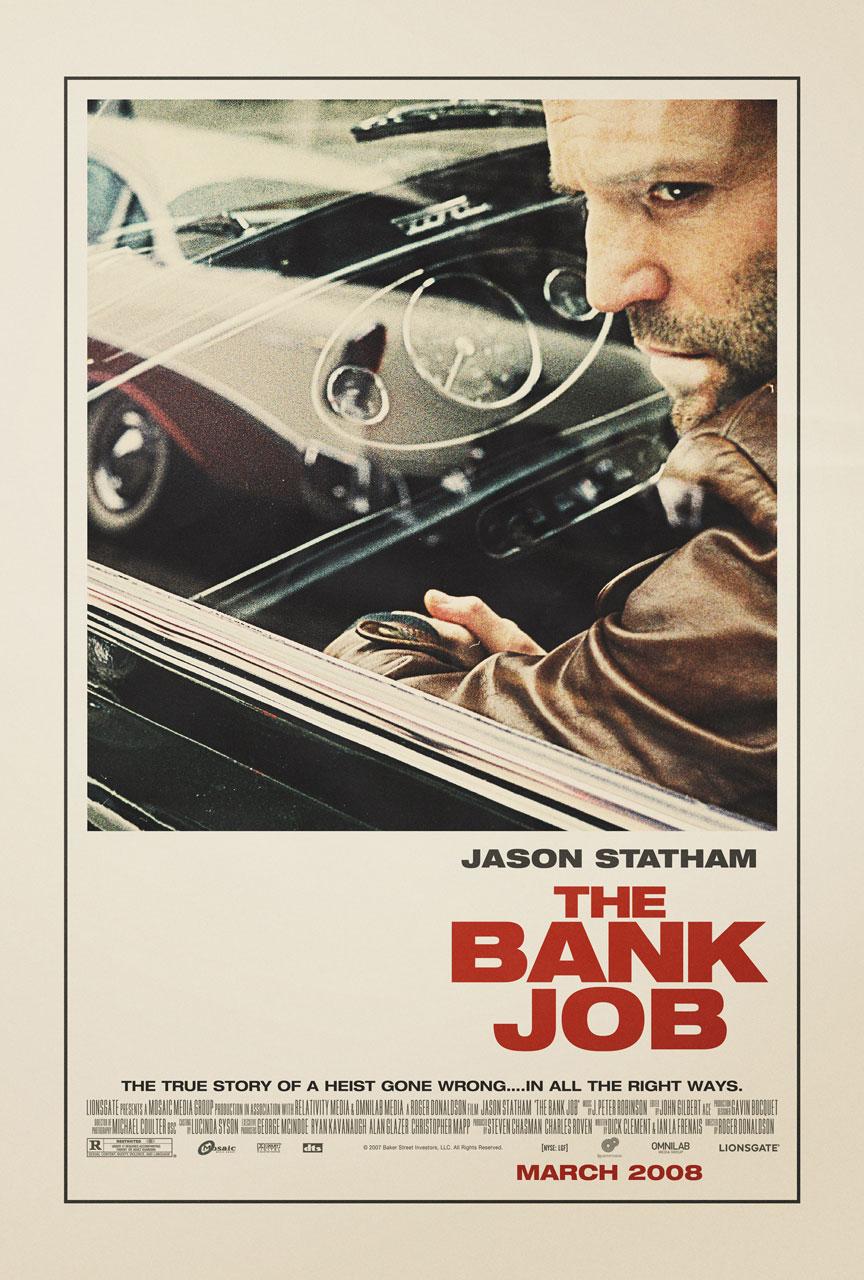
"The Bank Job" (Roger Donaldson, 2008)


Heist films of the past several years (namely the Ocean's series) revel in the caper itself. What kind of a crew do we need? The film goes on to explore the eccentricities of its several protagonists. What equipment do we need? Surely, some simple explosives and repelling devices are obvious. Then there is always some surprise device that heavily tilts the scales one way or the other. "The Bank Job" is a heist movie, but don't make the mistake of thinking it's just another clone. The film explores relatively unexplored territory for the "heist" movie: the fallout of the caper.

Within the first ten minutes, it seems that every character has been introduced. We may not know their place in the upcoming plot, but they all figure heavily. Very simply, a film that dares to keep all its cards face-up does not enjoy the luxury of twists. But "The Bank Job" isn't boring - it knows where it wants to go and efficiently propels us.

Efficient is the word that most comes to mind when describing this film. For instance (and this doesn't give anything away), the entire setup and bank robbery concludes at about the 1-hour mark. The film must have at least 20 minutes left right? What does "The Bank Job" choose to do with this extra time?

Remember the structure of "Ocean's 11" (Steven Soderbergh, 2001)? Soderbergh's caper spans the entirety of the film's running time. It takes a sequel to rummage through the opening film's fallout. "The Bank Job" manages to do both within one film.

Part of this is a smart move. The film's setting is in London of the 70s. Thus, the film makes no attempt to shock and awe us with the heist itself. So, back to the word efficient. The only ingredients in each scene are the pieces of information that we need. This quality can sometimes lend itself to short, curt scenes, but "The Bank Job" pulls off this tactic throughout the film and consequently establishes it as a sort of "style."

Let us return to the original question - what does "The Bank Job" do with the extra time? Again, it seems that most caper films choose to focus on the just that: the caper. And for good reason! It's fun and exciting to see how the perpetrators manage to pull off such a complicated plan. "Bank Job" wants to know what happens to those that lose their belongings. How do they react - with calculated resolve or with unfocused activity?

Although the two film's aren't comparable (in esteem or subject matter), I think they are in subtle tonality - "The Queen" (Stephen Frears, 2006) and "The Bank Job." Nothing flashy. No surprises. Efficient filmmaking. Previously, I have thought of "The Queen" as close to a "perfect" film as possible. A perfect film is one in which you would not change any thing about it - scene, dialogue, production design, etc. In my opinion this leads to an efficient film.

In retrospect, "The Bank Job" isn't as good as I thought it would be. Now, this comes after hearing the buzz surrounding a better-than-average film released at a lesser-than-average box office time. It's good. Maybe a 7 out of 10. No masterpiece, but if you want an example of contemporary efficient filmmaking, check out "The Bank Job." And a good efficient film is better than an inconsistent and longer piece.

Sunday, August 10, 2008

"Mad Men" (Matthew Weiner, 2007)


Mad Men is one of those shows that makes you feel cool simply by sitting in front of the television. But it's a different kind of cool - a more nostalgic and retro kind of cool. In short, Mad Men really makes you wish you were alive in such a time.

What time is this exactly? It's a time when downing three martinis at lunch wouldn't turn a single head, all this coming after a two-drink meeting with a client before the siesta. Oh, and don't tell your doctor but you've already consumed a pack of cigarettes and are working on your second of the day and it may not be your last. Okay, enough with the vices.

Mad Men hits at why we watch visual fiction in the first place - displacement of the emotional self. In other words: escape. Cigarettes are still a part of our current culture, although certain restrictions have made it less available. Alcohol in much the same way, but it has been censored from our life between the hours of 9 to 5. After that, the floodgates open. Mad Men reminds us where we come from - our (Gen. X) origins. This is the lifestyle of our parents.

Where do we see this in the Emmy-nominated drama? No, not in the lives of the (mad) men. It is perhaps the women who are the most compelling of the gender groups (keep in mind, this is a male-written blog). If you're not paying attention, their suits look at least similar to current fashion trends. Female attire does look quite different. Skirts flare out and hair is tapered and delicately structured. It is in the female world that the cultural politics of the time seep through the screen. Sure, the men of work allude to certain historical moments, but it is within the women (and consequently the home) that one discovers America's identity.

I believe it is not just the presence of the female, but specifically the absence of the male that allows such possibilities. The cultural environment of Mad Men, is quite segregated between men and women. Men have their time in the workplace and women (seemingly) bide their time at home. The men are constantly involved with office politics and which secretary or phone operator satisfies their visual appetite. In fact, and not surprisingly, it is only when the two gendered worlds collide is when the tension heightens. Sure, the ad men have their squabbles but for the most part they dissipate in short order. No, the lingering conflict with Mad Men is between the male and the female. Don Draper (Jon Hamm) constantly flip flops between being faithful to his wife Betty (January Jones), but does maintain regularly scheduled appointments with another woman. It's hard to figure out where his romantic loyalties lie.

Women appear to have no real power. Men have the freedom to explore their romantic desires and escape out of the treacherous confines of the home. The women are trapped with their one-and-only male partners, whoever they may be and to whomever they may already be attached. Women do not have the recourse of leaving their loveless marriage unless the man frees her, but this is not a desirable position as it leaves the woman without financial support. No, the women occupy their time discussing the pregnancy situations of their neighbors and the social lives of presidential candidates.

Men exert their prowess between the hours of 9 to 5, but they can only do so within the office. It is within this same time-frame that women exert their own kind of prowess within the home world. They raise the kids and maintain the home - the same home that the working man must eventually return - but they also socialize among themselves.

The one anomaly in this whole equation is Peggy Olson (Elizabeth Moss, formerly of The West Wing). She exists within the working world. Okay, no problem, so do many other secretaries. However, Peggy managed to advance within the company and consequently into the world of men in the working world!

And so, this is the question that lingers for Mad Men. Which genre of woman will be the catalyst for the upstart females: the challenging Peggy in the working world, or the subtly subversive Betty Draper of the home world. I think if history is to be any counsel, then both sets of women may serve as a dual wedge supplanting the epochal dominance of the XY chromosome.

Why do I enjoy this show? I enjoy the 3-martini lunch concept as well as the massively-flared skirt. 6 rounds of oysters at lunch anyone? This drama exudes an air of nonchalance about most anything. As unfaithful as the men are, it never occurs to them that their domestic life may be crumbling. It can only come from overconfidence in...something. They can cheat and get away with it. I enjoy the stark balance between work and home. Home seems so inviting, but it is ultimately the most hostile of environments. Check the stock of the liquor cabinets!